Digital Protection vs Identity Theft Roller Stamps: How to Safeguard Your Personal Data

An identity theft protection roller stamp covers names, addresses, account numbers, and other printed personal details with a dense ink pattern before you throw away or recycle paperwork. It is useful for hiding information on envelopes and some shipping labels, but it cannot guarantee that every document becomes unreadable.
The biggest mistake is treating a privacy stamp like a paper shredder. A stamp covers the printing while leaving the document intact. On glossy labels, coated paper, and some receipts, the ink may smear or leave the original text visible. Financial statements, medical records, and documents containing sensitive identity information are generally better shredded.
For families sorting delivery boxes, school letters, prescription packaging, and household bills, a roller stamp can still save time. The key is knowing which materials it works on, how to check the coverage, and when to use a more secure disposal method.
What Is an Identity Theft Protection Roller Stamp?
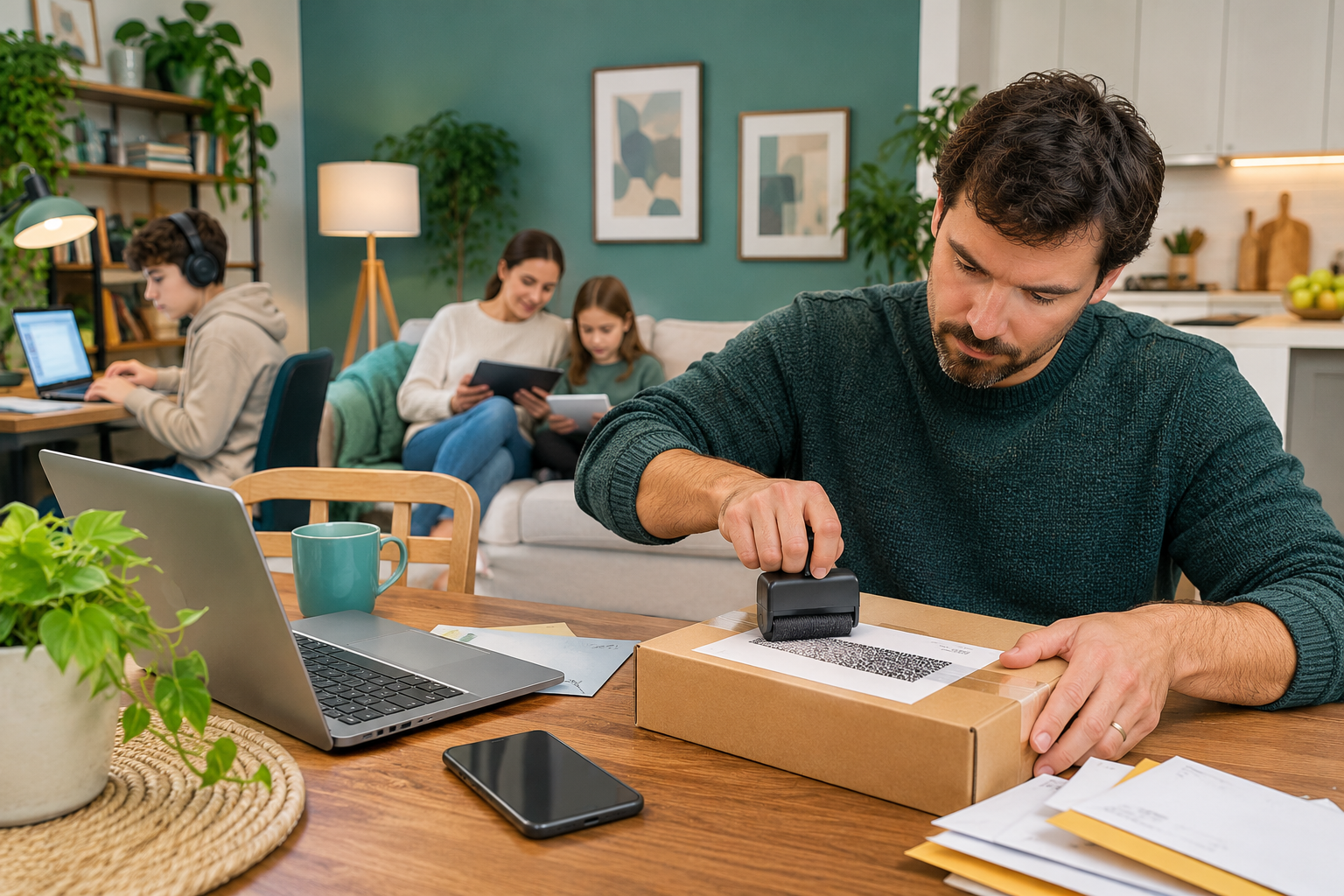
An identity theft protection roller stamp is a handheld device that obscures printed information using a repeating pattern of dark ink.
Unlike a regular office stamp, it does not print a name, address, or date. Its purpose is to make existing text difficult to read.
You roll the device over the information you want to conceal, usually in one or more overlapping passes.
For example, an online order arrives with your full name, street address, apartment number, and phone number printed on the shipping label.
You want to recycle the cardboard box, but you do not want those details clearly visible in a shared recycling area.
A privacy stamp can cover the printed information without requiring you to remove the entire label, provided the ink works on that material.
This is where the tool is most useful: small areas of identifying information on otherwise ordinary packaging or mail.
It is not designed to protect online accounts, erase digital records, or guarantee that sensitive information cannot be recovered from paper.
How an identity protection roller stamp works
Most privacy roller stamps contain three basic parts:
- Rotating roller: Moves across the paper and applies the masking pattern.
- Ink supply: Holds the dark ink used to obscure the original printing.
- Protective cap: Covers the roller during storage and helps prevent accidental ink marks.
The roller applies many small, overlapping marks across the text.
This makes it harder to distinguish the original letters and numbers from the masking pattern.
Different products use different designs. Some print repeating characters, while others use closely packed shapes or irregular patterns.
A dense pattern generally provides better visual interference than a few simple lines drawn over the text.
However, the pattern alone does not determine how well the stamp works.
Ink coverage, surface texture, pressure, and drying behavior also matter.
On an ordinary paper envelope, the ink may settle into the paper and remain clearly visible.
On a glossy shipping label, the same ink might sit on the surface, smear when touched, or fail to cover the printing evenly.
That difference is why a stamp should be tested on the material you intend to use.
What information can a roller stamp hide?
A privacy roller stamp can help cover small sections of printed information, including:
- Full names
- Home addresses
- Telephone numbers
- Email addresses
- Customer reference numbers
- Order identification details
- Partial financial account numbers
- Prescription label information
- Details printed on promotional mail
Some of this information is not especially sensitive on its own.
For example, a mailing address may already appear in public records or business directories.
Still, there is no benefit to leaving unnecessary copies of your household details visible on discarded packaging.
A delivery label might reveal where you live, your phone number, and which retailer shipped the parcel.
An envelope from a medical provider could reveal information about where someone receives care.
A school letter might contain a child’s name, home address, and student reference number.
Covering identifying details can reduce casual exposure.
However, a stamp is not a reliable way to destroy highly sensitive records. If a document contains a Social Security number, detailed financial information, or extensive medical records, shredding is generally the better choice.
How to Use an Identity Theft Protection Roller Stamp Correctly
A roller stamp requires little setup, but applying ink carelessly can leave readable information behind.
The goal is complete, durable coverage on a compatible surface.
Step 1: Identify the information that needs protection
Before stamping, look over the whole document or package.
Find every area containing identifying details.
A shipping label may include your name and address in large print, with a phone number or tracking reference elsewhere.
A utility notice might display a customer number near the top and a service address at the bottom.
A medical envelope may show a patient’s name through a transparent window.
Do not assume the first visible address block is the only information worth protecting.
For a delivery box, check:
- The main shipping label
- Return address details
- Additional tracking stickers
- Old labels from previous shipments
- Printed customer reference numbers
- Barcodes and QR codes that may contain or reference shipment information
A barcode does not necessarily contain your complete address, but some codes encode or link to identifying shipment details.
If you do not need the code to remain readable, consider removing or obscuring it along with the printed information.
Keep the original label intact until you no longer need it for a return, warranty claim, or delivery dispute.
Step 2: Check whether the surface accepts ink
Look at the material before applying the stamp.
Ordinary paper envelopes are generally easier to cover than glossy or laminated shipping labels.
If you are using the stamp on a new surface, test a small area that does not contain important information.
Roll the stamp across that area and let the ink dry according to the product instructions.
Check whether the ink:
- Covers the material evenly
- Remains dark after drying
- Smears when rubbed
- Forms gaps in the masking pattern
- Transfers onto your fingers
- Leaves printing visible underneath
Some manufacturers specifically advertise ink suitable for glossy or coated paper.
Others design their products primarily for ordinary stationery.
Read the product information rather than assuming all privacy stamps use the same ink.
If the ink fails to adhere, do not continue making repeated passes indefinitely.
Remove the label and destroy it separately where practical.
Step 3: Roll across the complete text area
Place the stamp slightly before the first character you want to cover.
Apply steady pressure and move the roller across the text.
Avoid pressing so hard that the roller stops moving smoothly.
A consistent movement usually gives more even coverage.
If the printed information is wider than the roller, make overlapping passes.
For a mailing address, cover the name, street address, apartment information, city, state, and postal code.
Check the edges carefully.
It is easy to hide most of a surname while leaving several letters visible.
A good result: The original characters cannot be distinguished through the masking pattern under normal viewing conditions.
A poor result: Letters, numbers, or complete words remain visible between the ink marks.
If the surface accepts the ink but the first application is incomplete, another overlapping pass may improve coverage.
Do not assume that more ink always solves the problem. Some surfaces simply do not work well with the stamp.
Step 4: Let the ink dry and inspect the result
Allow the stamped area to dry before handling the paper.
Drying time depends on the ink formulation, material, and conditions.
Do not immediately stack the stamped label against another document.
Wet ink may transfer and leave the original text exposed.
Once dry, examine the covered area under good lighting.
Tilt the document slightly.
Glossy labels can reflect light differently from ordinary paper, making the underlying printing easier to notice from certain angles.
Check whether any characters remain visible.
If the stamp has covered the information poorly, use another disposal method.
For a highly sensitive document, do not rely on the stamp even if the surface appears completely dark.
Step 5: Dispose of the paperwork appropriately
After covering the information, decide how the document should be discarded.
An ordinary envelope with a fully obscured address may be suitable for recycling.
A financial statement containing account balances, transactions, and extensive personal details should generally be shredded.
For delivery packaging, inspect all labels before recycling the box.
For medical documents, consider whether the paperwork contains information beyond the small area you stamped.
Local recycling rules also matter.
Adhesives, plastic labels, and coated materials may need different handling from ordinary paper.
The privacy stamp does not change the underlying material or automatically make it recyclable.
Where Identity Protection Roller Stamps Work Best
A stamp that performs well on office paper may not work reliably on a receipt, plastic bottle, or coated mailing label.
The material should determine which privacy method you use.
Paper envelopes and everyday mail
Ordinary envelopes are one of the most practical uses for a privacy roller stamp.
Most have a small address area that can be covered quickly.
For example, you might receive a promotional letter showing your name, address, and a customer reference number.
If the contents are not sensitive, obscuring those details before recycling the envelope may be sufficient for everyday privacy.
Check both sides first.
Some envelopes include identifying information near the postage area or return address.
Window envelopes deserve extra attention.
The visible information may actually be printed on the document inside.
Removing the contents and stamping only the envelope does not protect the enclosed document.
If the letter contains financial or medical information, decide whether it should be securely stored or shredded.
Shipping labels and cardboard boxes
Online shopping creates a regular supply of packaging with personal information.
A family ordering household supplies, electronics, clothing, and school materials may receive several different label types.
Some labels are made from ordinary paper.
Others have a glossy coating or plastic-like finish.
The same stamp may work differently on each one.
If your roller is suitable for the label, cover the identifying text and inspect the result after drying.
Check the package for additional stickers.
A returned or reused box may contain an old shipping label beneath the current one.
For difficult labels, removal is often simpler.
Peel off the label if possible.
If it tears, remove the pieces containing identifying information.
Shred them when the material is suitable for your shredder, or use another secure disposal method appropriate for the material.
Do not force adhesive-backed plastic into a shredder that is not designed to handle it.
Prescription labels and medical packaging
Prescription packaging deserves more care than ordinary mail.
A label can display:
- Patient name
- Medication name
- Prescription number
- Dosage instructions
- Pharmacy information
- Prescriber details
Some of this information may be sensitive even when it does not include a financial account number.
A roller stamp may work on a flat paper label.
It is less convenient on small, curved prescription bottles.
The roller may not make full contact with the label, leaving gaps near the edges.
Glossy labels can also cause ink adhesion problems.
If the stamp does not cover the information reliably, remove or thoroughly obscure the identifying label.
Keep medication instructions and packaging while they are still needed.
Follow appropriate guidance when disposing of unused or expired medication.
Do not remove important instructions from medicine that someone in the household is still using.
Receipts and thermal paper
Many store receipts use thermal paper.
The text is produced through a heat-sensitive coating rather than conventional printing ink.
That can affect how a privacy stamp behaves.
Some masking inks may smear or fail to provide consistent coverage on thermal paper.
Test the stamp on a similar receipt before relying on it.
Look at the result after drying.
Also check what information the receipt actually contains.
Many payment receipts display only part of a card number, but some may include other identifying details, account references, or transaction information.
A receipt that only lists ordinary groceries may not require the same handling as one containing sensitive financial or medical details.
For receipts with important personal information, shredding is generally preferable.
If you need the receipt for a return, reimbursement, or tax record, store it until it is no longer required.
Glossy, laminated, and plastic surfaces
These surfaces are where roller stamp performance can become unreliable.
Ink that absorbs into paper may sit on top of plastic or a glossy coating.
It can smear when touched or separate into uneven patches.
Some specialty privacy stamps are formulated for coated surfaces, but compatibility varies by product.
Look for specific claims about the materials you need to cover.
If a manufacturer only mentions paper envelopes, do not assume the device will work on laminated labels.
Test the material and inspect the result.
If the original text remains readable, switch methods.
Removing a label or securely destroying the sensitive portion is better than leaving it covered by ink that can rub away.
Identity Theft Protection Roller Stamp vs Paper Shredder
A privacy stamp obscures selected information. A shredder physically breaks the document apart.
That difference is more important than convenience when dealing with sensitive records.
| Feature | Roller Stamp | Paper Shredder |
|---|---|---|
| Main function | Covers printed information | Physically destroys paper |
| Best use | Envelopes and compatible labels | Sensitive documents and financial records |
| Time required | Quick for small text areas | Convenient for whole pages or batches |
| Paper remains intact | Yes | No |
| Depends on ink compatibility | Yes | No |
| Handles large amounts of sensitive text | Not ideal | Generally more appropriate |
| Maintenance | Refilling or replacing ink | Emptying and maintaining cutting mechanism |
| Main limitation | Text may remain visible or recoverable | Poor shredding may leave reconstructable pieces |
When a roller stamp is enough for everyday privacy
A roller stamp makes sense when only a small area of otherwise ordinary paperwork contains identifying information.
For example, you receive a promotional envelope showing your name and home address.
There are no financial records or sensitive documents inside.
If the stamp fully obscures the address, it may be a reasonable way to prepare the envelope for recycling.
The same applies to compatible shipping labels where you only need to hide basic delivery details.
The important distinction is the sensitivity of the information.
Covering an address on packaging is different from attempting to protect a complete bank statement.
When shredding is the better choice
Use shredding for records containing extensive personal, financial, or medical information.
Examples include:
- Old bank statements
- Credit reports
- Financial account applications
- Unneeded tax records
- Sensitive insurance correspondence
- Documents displaying Social Security numbers
- Medical statements containing treatment or billing details
- Pay statements containing personal identifiers
- School forms containing extensive family information
The Federal Trade Commission recommends shredding documents containing personal or financial information before discarding them.
Cross-cut and micro-cut shredders generally make reconstruction more difficult than simple strip-cut shredders.
Choose a shredder appropriate for the volume and sensitivity of the documents you handle.
If you do not own one, some communities, financial institutions, and document disposal companies offer shredding services.
You can also review the FTC’s guidance on which documents to keep and shred.
Do not shred documents that you are legally or financially required to retain.
What about an ordinary black marker?
A black permanent marker can sometimes be more practical than a roller stamp.
It is easier to control on small, curved, or uneven surfaces.
For example, you may find it easier to cover a narrow label on a prescription container using a marker.
However, a marker is not automatically more secure.
A single line of ink can leave original letters visible.
On some surfaces, the ink may smear or fail to adhere.
The same rule applies to both tools: inspect the result after the ink dries.
If the information remains readable, use another method.
For documents containing extensive sensitive information, shredding is the better choice.
How to Choose the Right Identity Protection Roller Stamp
A privacy stamp should match the paperwork you actually handle.
Before buying one, think about how often you receive mail, what kinds of labels you discard, and whether you already have access to a shredder.
Check the ink type and surface compatibility
Start with the manufacturer’s stated surface compatibility.
Some rollers are designed for ordinary paper.
Others use ink intended for coated or glossy materials.
Do not assume the word permanent means the ink will adhere to every surface.
A product may perform well on an envelope but poorly on a plastic shipping label.
Look for specific information about:
- Standard paper
- Envelopes
- Coated labels
- Glossy paper
- Plastic surfaces
- Shipping labels
If the description does not explain the supported surfaces, be cautious about relying on the stamp for anything beyond basic paper.
Also check whether the ink is likely to bleed through thin material.
A privacy stamp should conceal information without damaging documents you still need.
Consider the roller width
Roller width determines how much information the device covers in one pass.
A narrow roller can be useful for small labels, individual lines, or limited areas of text.
A wider roller may cover a mailing address more quickly.
For example, if you routinely process envelopes with several lines of address information, a wider stamp may reduce the number of passes needed.
However, a wide roller can be awkward on a small prescription label.
Choose based on your most common use.
A larger roller is not necessarily more secure.
Coverage quality matters more than the amount of ink applied in one movement.
Look for a dense masking pattern
Examine the masking pattern shown in the product description.
The pattern should be designed to interfere with the readability of existing text.
Widely spaced lines may leave parts of letters and numbers visible.
A dense pattern may provide better visual interference, provided the ink covers the original printing effectively.
Be skeptical of broad claims such as complete identity theft prevention.
A stamp cannot prevent online account theft, data breaches, or financial fraud.
Its function is limited to obscuring physical information.
Check whether the ink can be refilled
Some privacy stamps are refillable.
Others use replaceable cartridges or sealed ink supplies.
If you frequently receive parcels or promotional mail, refill availability may affect long-term convenience.
Check whether replacement ink is available for the exact model.
Do not use an unrelated ink simply because it has the same color.
Different formulations can affect drying, adhesion, and the roller mechanism.
Follow the manufacturer’s instructions when refilling.
If the stamp is not designed to be opened, forcing it apart may damage the device.
Consider handling and storage
A privacy stamp should feel comfortable to use.
Look for a grip that allows controlled pressure and a cap that stays securely attached.
If several adults in the household use the device, a simple design may be more practical than one requiring frequent adjustments.
Consider where you will store it.
A drawer near the mail-sorting area may be convenient, but keep the stamp away from children who might accidentally mark furniture, clothing, or important documents.
Also check whether the roller can be cleaned.
Paper fibers and dust may collect around the mechanism and cause uneven ink application.
A stamp that leaves broken patterns should be cleaned, refilled, or replaced according to its instructions.
Why Paper Privacy Still Matters for Families
Digital security receives a great deal of attention, but household paperwork still contains personal information.
Parents receive school notices, insurance statements, shopping deliveries, medical letters, and financial correspondence.
Some of these documents are worth keeping.
Others can be discarded once they are no longer needed.
The challenge is deciding which disposal method is appropriate.
Protecting household addresses and contact information
Names, addresses, and phone numbers appear on ordinary household paperwork.
These details are not always confidential, but discarded documents can provide someone with a convenient collection of information about a family.
For example, a package might show your full name, apartment number, and telephone number together.
A medical envelope may identify a healthcare provider.
A school mailing could connect a child’s name with a home address.
Masking unnecessary details reduces casual exposure.
However, covering an address label does not prevent someone from obtaining the same address through other sources.
A roller stamp is a basic privacy measure, not a guarantee of anonymity.
Handling children’s school paperwork
School forms can contain more information than parents initially realize.
A completed form may include:
- Student name
- Date of birth
- Parent contact information
- Home address
- Emergency contacts
- Medical details
- Student identification numbers
A privacy roller is not the right tool for destroying a form containing several sections of sensitive information.
If the document must be retained, store it securely.
If it is no longer needed and contains substantial personal details, shred it.
For a simple mailing envelope, masking the address may be sufficient.
Also check whether the document contains signatures or identifying information on the reverse side.
Do not stamp original school records that may need to be presented again.
Reducing unnecessary exposure of medical information
Medical letters, insurance notices, and pharmacy paperwork can contain private details.
A healthcare statement may reveal a patient’s name, provider, treatment information, or billing reference.
Covering one line does not protect the rest of the page.
Keep documents needed for treatment, insurance claims, or financial records.
For paperwork that no longer needs to be retained, consider shredding it rather than stamping selected sections.
Prescription packaging requires a slightly different approach.
If the container is empty and ready for disposal, remove or thoroughly obscure identifying labels where practical.
Do not remove medication instructions from packaging that someone still needs.
Medical privacy requires careful handling, not simply applying more ink.
Managing online shopping packaging
Online shopping can leave a family with numerous boxes and padded envelopes.
Most contain some identifying information.
A typical shipping label may display a name, delivery address, and shipment reference.
Some also include phone numbers or machine-readable tracking codes.
Before recycling a package, check every side.
Remove old labels from reused boxes where practical.
If you use a privacy stamp, confirm that its ink works on the label material.
For labels that cannot be reliably covered, removal is often the better option.
Also check whether the package may need to be returned.
Keep tracking information and other necessary details until the return period or delivery issue is resolved.
Combining physical privacy with digital protection
A privacy stamp protects information on physical materials.
It cannot detect phishing, stop malicious downloads, or prevent unauthorized access to online accounts.
Those risks require different protections.
For a family using phones, laptops, and tablets, useful habits include:
- Keeping devices and browsers updated
- Using unique passwords for important accounts
- Enabling multi-factor authentication
- Checking unexpected links before opening them
- Reviewing account security notifications
- Monitoring sensitive accounts for unusual activity
- Using appropriate device security tools
AVO Security provides phishing protection, breach alerts, and multi-device security features for supported household devices.
You can review the available protections through AVO Security when planning security for your family’s phones, tablets, and computers.
The two approaches address different risks.
A privacy stamp reduces exposure from discarded paperwork. Digital security tools help protect devices, accounts, and online activity.
Neither should be treated as a replacement for the other.
Common Mistakes That Reduce Roller Stamp Effectiveness
A roller stamp can appear to have covered a label even when important details remain readable.
Most problems come from incomplete coverage or using the wrong ink for the surface.
Applying only one light pass
A quick pass may leave gaps in the masking pattern.
This is especially common near the beginning and end of the roller movement.
Use steady pressure.
Check the result before discarding the document.
If the ink works on the material, a second overlapping pass may help.
If the text remains visible, switch to a more reliable disposal method.
Ignoring glossy labels
A glossy label may look dark immediately after stamping.
Once the ink dries, the original text may become visible through uneven coverage.
Some inks can also be rubbed off the surface.
Check the manufacturer’s compatibility instructions.
If the ink smears or fails to adhere, remove the label or destroy the sensitive portion another way.
Covering only the first line of an address
Mailing labels often contain several lines of identifying information.
Covering the name while leaving the street address visible provides incomplete protection.
The same applies to account numbers and customer references.
Inspect the entire label and cover all relevant details.
Forgetting barcodes and additional labels
A box may contain more than one sticker.
The main shipping label might show an address, while another sticker contains tracking or order information.
Some barcodes may encode or reference shipment details.
Check whether those details need to remain available before disposal.
If they do not, remove or obscure unnecessary identifying information.
Assuming a roller stamp makes every document safe to discard
A stamped document still exists.
The information may remain visible under certain conditions, and other sensitive details may appear elsewhere on the page.
A privacy stamp should not be used as the sole method for disposing of detailed financial, medical, or identity records.
Use shredding for documents containing substantial sensitive information.
Using a worn-out roller
A roller that is low on ink may leave faint or patchy marks.
Paper dust can also affect the masking pattern.
Inspect the stamp periodically.
Refill, clean, or replace it according to the manufacturer’s instructions.
Do not use a roller that consistently leaves readable text exposed.
A Practical Home Routine for Protecting Personal Documents
The easiest time to handle paper privacy is when documents first arrive.
A simple sorting system prevents sensitive records from accumulating in drawers, on kitchen counters, or beside the recycling bin.
Keep three separate categories
Divide household paperwork into three groups.
Keep securely
This includes records you may need for identification, medical care, financial matters, taxes, property ownership, or legal purposes.
Examples include birth certificates, current insurance documents, important medical records, and active financial agreements.
Store them securely.
Stamp or obscure
Use this category for ordinary mail and packaging containing small amounts of identifying information.
Examples include envelopes, promotional letters, and compatible shipping labels.
Inspect the result before disposal.
Shred
Use this category for documents containing extensive personal, financial, or medical information.
Examples include old financial statements, unneeded credit reports, and sensitive account correspondence.
If you do not own a shredder, keep these documents in a secure location until you can use a trusted shredding service.
Set up a small mail-handling area
Choose a consistent location for sorting mail.
Keep a privacy stamp nearby, along with a container for recycling and a separate secure place for documents waiting to be shredded.
When mail arrives:
- Open the envelope and remove the contents.
- Decide whether the document must be retained.
- Inspect the envelope for identifying information.
- Use the stamp only on suitable low-sensitivity material.
- Place sensitive documents in the shredding pile.
- Store important records securely.
For delivery boxes, check labels before breaking down the cardboard.
Avoid leaving financial or medical paperwork in an open recycling container while waiting to dispose of it.
A simple routine is more useful than a complicated system that nobody follows.
Review documents before major household changes
Moving, changing banks, switching insurance providers, or replacing household services can create extra paperwork.
These are good opportunities to review what should be retained.
Old utility statements, account notices, and delivery records may accumulate during a move.
However, do not throw away important records simply because they are old.
Different documents have different retention requirements.
Tax records, property documents, insurance agreements, and employment paperwork may need to be kept for specific periods.
Confirm the relevant requirements before disposal.
A privacy stamp helps with information masking. It does not determine how long records should be retained.
Know what to do if personal information is already exposed
Sometimes paperwork is discarded before anyone notices the identifying information.
The response should depend on what was exposed.
An envelope showing a home address presents a different risk from a document containing a Social Security number, complete financial details, or extensive medical information.
If sensitive information may have been exposed:
- Review relevant accounts for unfamiliar activity.
- Check important financial statements and notifications.
- Contact affected institutions when necessary.
- Consider a credit freeze or fraud alert when appropriate.
- Monitor for suspicious account applications or identity-related correspondence.
- Report suspected identity theft through official channels.
In the United States, IdentityTheft.gov provides identity theft reporting and recovery guidance.
Do not assume that an accidentally discarded address label means identity theft has occurred.
Consider the type of information involved and whether there is evidence of misuse.
FAQ
Does an identity theft protection roller stamp really work?
A roller stamp can make printed information harder to read when the ink properly covers the text. Its effectiveness depends on the masking pattern, ink formulation, surface, and application. It is useful for everyday mail, but sensitive financial and identity documents should generally be shredded.
Can a roller stamp hide information on glossy paper?
Some privacy roller stamps are formulated for glossy or coated paper, while others work best on ordinary paper. Check the manufacturer’s instructions and test the result after the ink dries. If the ink smears, rubs off, or leaves text visible, remove or securely destroy the label instead.
Is an identity protection roller stamp better than a shredder?
A roller stamp is more convenient for hiding small areas of information on envelopes and compatible labels. A shredder is generally better for documents containing extensive financial, medical, or identity information because it physically destroys the paper. Many households benefit from using both for different tasks.
Can someone still read information after it has been stamped?
Yes, especially if the ink coverage is incomplete or the surface does not accept the ink properly. Original printing may remain visible through gaps, smears, or uneven application. Inspect stamped information carefully and shred highly sensitive documents rather than relying only on masking ink.
Can I use an identity protection stamp on prescription bottles?
Some stamps may work on prescription labels, but curved bottles and coated materials make even coverage difficult. Check whether the ink adheres properly and whether the identifying information remains readable. Removing or thoroughly obscuring the label is often more practical before recycling an empty container.
Do I still need digital identity protection if I use a roller stamp?
Yes. A roller stamp only obscures information on physical documents and packaging. It cannot prevent phishing, account breaches, malicious downloads, or stolen passwords. Family devices and online accounts need their own security measures, including strong authentication, software updates, and appropriate protection tools.
An identity theft protection roller stamp is worth considering if your household regularly discards envelopes and shipping labels containing personal information. Choose one that works on the materials you use, check the ink coverage after every application, and do not rely on it for sensitive records. Keep the stamp near your mail-sorting area and use shredding whenever the information deserves stronger protection.